My joint paper (with Ryan Timms, whose Masters I was supervising while it was written) called ‘Hostile Scaffolding’ has taken off nicely since being officially published in Philosophical Papers in August of 2023. Nicely as in people have been reading it, and finding it useful, and referring to it in their own work. (The abstract of the paper is copied at the bottom of this post.) This is very encouraging, especially because this paper had a bumpy start, with two or three desk-rejections, as well as being rejected after review at two other journals before it found a home. That’s all fine, and is partly the occupational hazard of interdisciplinary work. Also, the reviews helped improve and clarify the exposition, and the rejections and delays gave us more chances to present talks on the argument and get our own thoughts into better shape.
What I want to explain briefly here is how the whole thing kicked off in a very accidental way. Ryan had approached me as a possible supervisor, and wanting to work on extended consciousness. I said that I was very interested in extended cognition, but didn’t particularly care about extended minds, or keep up with the huge and rapidly moving field of research on consciousness. So if what he really wanted to work on was consciousness, I should help him figure out who he should be talking to. If, on the other hand, he was prepared to spend some time reading and talking about extended cognition, maybe we could find a topic that would work for both of us. Ryan was up for trying that, and I suggested Clark’s Being There and Sterelny’s Thought in a Hostile World among the first few things to read and discuss together.
At a later meeting, I blurted out ‘maybe there could be “hostile scaffolding”.’ I’d never put those two words together, and they didn’t name a developed thought in my mind. I really was just trying to come up with things that weren’t about consciousness. And I was doing that while talking about how part 1 of Thought in a Hostile World is a corrective to the thought voiced in early distributed cognition and situated robotics that agents should “treat the world as its own best representation” (and so not need as much cognition, if they needed any at all). But the combination struck us both as interesting. We kicked it around a bit, and I suggested a few more things to read, including Natasha Dow Schüll’s terrific book Addicted by Design. (I’d worked on gambling addiction before, so it was a salient area to look for exhibits.) Quite soon we had a shared idea of how to move forward, Ryan had the first draft of a research proposal, and we had a schematic outline to start separately writing the paper.
My own thinking about this had quite a lot of philosophy of biology in it, including Dawkins’ The Extended Phenotype, and the Krebs and Dawkins chapter on ‘Mind-reading and manipulation’. And earlier versions of the Hostile Scaffolding paper had a section on that, but it was actually a detour from the core argument, didn’t really work when edited down to 2000 or so words, and got cut. (This later grew into a separate piece called ‘The Extended Cuckoo’ which I presented at The Extended Mind @25 conference in 2023, and in a different form as the second chapter of Engines of Hostility.)
Still, if I hadn’t been keen to engage the interest of a cool student at the same time as being keen to avoid talking about consciousness, this wouldn’t have happened when it did.
(Ryan finished his Masters and is now doing a PhD at TU Delft.)
Abstract of Hostile Scaffolding:
Most accounts of cognitive scaffolding focus on ways that external structure can support or augment an agent’s cognitive capacities. We call cases where the interests of the user are served benign scaffolding and argue for the possibility and reality of hostile scaffolding. This is scaffolding which depends on the same capacities of an agent to make cognitive use of external structure as in benign cases, but that undermines or exploits the user while serving the interests of another agent. We develop criteria for scaffolding being hostile and show by reference to examples including the design features of electronic gambling machines and casino management systems that hostile scaffolding exists and can be highly effective. In cases where the scaffolding is deep and permits the offloading of significant cognitive work, hostile scaffolding exploitatively manipulates cognitive processing itself. Given the extent of human reliance on scaffolding this is an important and neglected vulnerability.
Links: Published version | Preprint on PhilPapers
References:
Clark, A. (1997) Being There: Putting Mind, Brain and Body Together Again. Cambridge, Massachusetts: MIT Press.
Dawkins, R. (1982) The Extended Phenotype, Oxford: Oxford University Press.
Krebs, J.R., & Dawkins, R. (1984[1978]) Animal Signals: Mind-Reading and Manipulation. In J.R. Krebs and N.B. Davies (eds.) Behavioural Ecology: An Evolutionary Approach, second edition. Blackwell.
Schüll, N.D. (2012) Addiction by Design: Machine Gambling in Las Vegas. Princeton, NJ: Princeton University Press.
Sterelny, K. (2003) Thought in a Hostile World, Oxford: Blackwell.
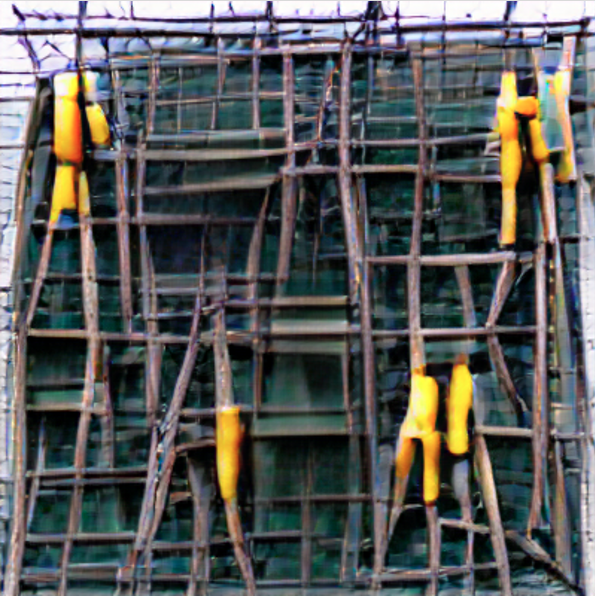
Picture: Dall-E response to the prompt
“Hostile Scaffolding” generated some
time in 2022. (I find this to be an
instructively lousy image.)
 David Spurrett
Leave a comment