Bodies and external resources make significant contributions to cognition by living beings and some artificial ones. This is now widely recognised, but not long ago the mainstream view was that cognition was exclusively internal and neural (or computational). The fact that cognition can extend into bodies and environments is generally presented as good news for users of technologies that augment or improve. There undoubtedly are benefits, but extended cognition brings vulnerabilities. Any agent might be useful to others, so we should expect those vulnerabilities to be found and exploited.
I’m working to catalogue and make sense of examples of this, and to develop an integrated view of the big picture. Engines of Hostility is the title of the final chapter of a book in progress on the big picture. (The book’s working title is “Whose mind is it anyway?”)
Papers linked to this project include:
Ryan Timms & David Spurrett (2023) “Hostile Scaffolding“. We argue that cognitive and affective scaffolding can undermine the interests of the agent who is scaffolded to the benefit of another agent. Our most detailed real examples concern features of electronic gambling machines, and player tracking systems in casinos. (Here is a preprint, if the published text is paywalled for you.)
David Spurrett & Nick Brancazio (2024) “Fashioning Affordances“. We argue that the notion of an ‘affordance’ in ecological psychology can be applied to some of the effects of clothing, because of how clothing can change what is possible or easy for a body to do. With the idea of an ‘affordance transforming technology’ in hand we go on to argue that ecological psychology can also accommodate insights from feminist criticism of some gendered clothing norms, including the expectation to wear high heeled shoes, and the persisting under-provision of pockets in clothes for women. (Here is a preprint, if the published text is paywalled for you.)
David Spurrett (2024) “On Hostile and Oppressive Affective Technologies“. I argue that affective technologies can be both hostile and oppressive, and consider examples including the cigarette (an exquisitely effective nicotine delivery system), casinos and electronic gambling machines (powerful technologies of motivational capture), and high-heeled shoes (that transform affectively embodied activity in ways that feminists have been explaining for ages).
David Spurrett, Giovanna Colombetti and John Sutton (2025) “Introduction: Scaffolding Bad – Varieties of Situated Cognitive Harm“. This is the introduction to an issue of Topoi that we co-edited. The brief was for papers on situated cognitive harm broadly understood, and the result was a varied and exciting collection of contributions. In this introduction we try to make some sense of where we are and where we’re going as far as ‘Scaffolding Bad’ goes.
David Spurrett (MS) “The Extended Cuckoo”. I presented this at the 2023 conference in Boulder celebrating 25 years of Clark and Chalmer’s paper ‘The Extended Mind’. (My paper’s sub-title is ‘The Extended Mind at 25 in Conversation with The Extended Phenotype at 41’.) Analogies between the ideas that minds and phenotypes can be extended are regularly made, but I argue philosophers of extended cognition should pay more attention to manipulation, which is central to Dawkins’ thinking. The conference organisers are planning an edited volume, which is currently in development hell. You can find a preprint here. (This hasn’t been peer-reviewed.)
Talks and working papers:
Nasty Niches – On how niche construction can be discriminating and harmful, and how both can be the function of a constructed niche. (Draws on Chapter Five of my book in progress.)
Epistemic Actions Reconsidered (or: I actively infer a riot) – On how ‘epistemic actions’ can be other-directed as well as self-directed, and hostile as well as beneficial. (Draws on Chapter Two of my book in progress.)
Cigarettes and the Engineering of Affect – On the cigarette as a vehicle of nicotine delivery (from the perspective of embodied affect and cognition) and on how niche-engineering and meaning manipulation supported its rise.
The Tower of Generate and Hack – in which I repurpose Daniel Dennett’s “Tower of Generate and Test” to talk about the variety of sources of hostility, and the different ways agents can be vulnerable to it. (Draws on Chapter Six of my book in progress.) Event on 26 March 2026.
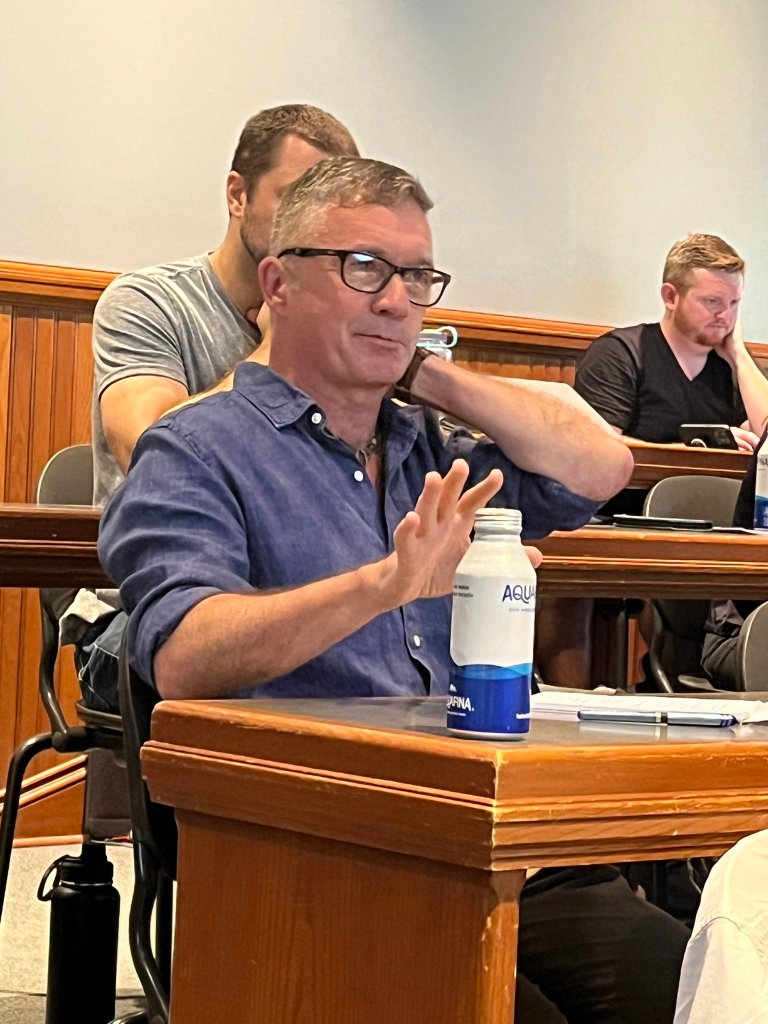
Asking a question at “The Extended Mind at 25” held in Boulder, Colorado in August 2023. (I presented “The Extended Cuckoo”.)

